
The Great Locomotive Chase: A Comprehensive Overview
Robert W. Smith’s detailed account, often found as a PDF, meticulously reconstructs the Great Locomotive Chase. His work delves into the daring Union raid, offering a comprehensive narrative of this pivotal Civil War event, based on extensive research.
Historical Context of the Chase
Robert W. Smith’s work, frequently accessed as a PDF document, places the Great Locomotive Chase firmly within the tumultuous backdrop of the American Civil War. The year 1862 witnessed the Confederacy gaining momentum, disrupting Union supply lines, particularly the vital Western & Atlantic Railroad. This railway served as a crucial artery for transporting Confederate troops and materials, making it a prime target for Union disruption.
Smith meticulously details the strategic importance of this railroad network, highlighting how its control was essential for both sides. The Union, reeling from early defeats, desperately sought ways to cripple Confederate logistics. The raid, conceived as a daring attempt to destroy bridges and disrupt communications, was a direct response to this strategic imperative. The PDF source emphasizes the political climate of the time, where bold, even reckless, actions were considered necessary to shift the war’s momentum.
Furthermore, Smith’s analysis reveals the broader context of Union reconnaissance and raiding operations in Confederate territory. The Chase wasn’t an isolated incident but part of a larger strategy to gather intelligence and harass the enemy. The PDF provides valuable insight into the challenges faced by both sides during this period, including logistical difficulties, communication breakdowns, and the constant threat of ambush. Understanding this historical context is crucial for appreciating the significance of the Great Locomotive Chase.
The Andrews’ Raid: Initial Planning
Robert W. Smith’s PDF account meticulously outlines the intricate planning behind what became known as Andrews’ Raid. The initial concept originated with Union spy James J. Andrews, who proposed a daring operation to seize a Confederate locomotive – the General – from the Western & Atlantic Railroad in Marietta, Georgia. This wasn’t a spur-of-the-moment decision, but a carefully considered plan developed over weeks, involving detailed reconnaissance and recruitment.
Smith’s research, detailed within the PDF, reveals that Andrews assembled a team of Union soldiers disguised as civilians. Their mission: to infiltrate Confederate territory, overpower the train crew, and drive the General north, destroying track and bridges along the way to disrupt Confederate supply lines. The PDF highlights the logistical challenges involved, including securing disguises, obtaining necessary tools, and coordinating movements to avoid detection.
The planning phase, as described by Smith, involved meticulous mapping of the railroad line, identification of key bridges and telegraph stations, and the development of contingency plans. The PDF emphasizes the risks involved, as any misstep could lead to immediate capture or failure. Andrews’ meticulous attention to detail, documented in Smith’s work, was crucial to the raid’s initial success, though ultimately, it wasn’t enough to prevent its eventual unraveling.

James J. Andrews and His Team
Robert W. Smith’s PDF provides a detailed portrait of James J. Andrews, the driving force behind the audacious raid. Andrews, a civilian scout and former railroad engineer, possessed intimate knowledge of the Western & Atlantic Railroad, a crucial asset for the operation. Smith’s account reveals Andrews as a resourceful and determined leader, willing to undertake immense personal risk for the Union cause.
The PDF meticulously identifies the twenty-two men who comprised Andrews’ team – a diverse group of Union soldiers, many with backgrounds in engineering, mechanics, or scouting. Smith details their individual roles and contributions, highlighting their bravery and commitment. These weren’t seasoned soldiers, but ordinary men tasked with an extraordinary mission, relying on Andrews’ leadership and their own ingenuity.
Smith’s research, presented in the PDF, emphasizes the importance of selecting men who could convincingly pose as civilians. Disguised as laborers, merchants, and even a farmer, they infiltrated Confederate territory undetected. The PDF underscores the challenges of maintaining their cover and the constant threat of exposure. Andrews’ careful selection process, as documented by Smith, was vital to the raid’s initial success, though the team’s diverse backgrounds also presented logistical hurdles.
The Union Raiders’ Objective
Robert W. Smith’s PDF clarifies the primary objective of the Great Locomotive Chase: to disrupt Confederate supply lines by destroying vital railroad infrastructure, specifically bridges and tracks, along the Western & Atlantic Railroad. This line was critical for transporting troops and supplies from the Deep South to the Confederate armies fighting in Tennessee and beyond.
The PDF details how the raid wasn’t intended as a large-scale military offensive, but rather as a daring act of sabotage. By disabling the railroad, the Union hoped to delay Confederate reinforcements and potentially alter the course of battles. Smith emphasizes that the operation was a high-risk, high-reward gamble, predicated on speed and surprise.
Smith’s account, meticulously documented in the PDF, reveals the strategic thinking behind targeting the railroad. The Union command believed that even a temporary disruption of the supply line would significantly hamper Confederate war efforts. The PDF also highlights the intelligence gathered prior to the raid, identifying key points along the line vulnerable to destruction. The raiders aimed to create chaos and logistical nightmares for the Confederate forces, buying time for Union advances.
The Chase Begins: Initial Stages
Robert W. Smith’s PDF vividly recounts the initial stages of the chase, beginning with the Union raiders, disguised as Confederate sympathizers, commandeering the Confederate locomotive, “The General,” from Marietta, Georgia. Smith details the meticulous planning involved in this audacious act, emphasizing the element of surprise and the raiders’ attempts to blend in.
The PDF illustrates how the raiders, led by James J. Andrews, immediately began their northward journey, systematically destroying sections of the railroad track and telegraph lines. Smith highlights the challenges they faced – maintaining speed, avoiding detection, and efficiently sabotaging the infrastructure. The initial phase was remarkably successful, with the raiders managing to put considerable distance between themselves and their pursuers.
Smith’s detailed narrative, presented in the PDF, emphasizes the growing alarm within the Confederate ranks as news of the stolen locomotive and disrupted lines spread. The Confederate response was initially slow, hampered by disbelief and a lack of immediate coordination. However, as the raiders progressed, the Confederate authorities mobilized, initiating a relentless pursuit that would define the subsequent stages of the chase, as thoroughly documented in the PDF.
Confederate Pursuit: William A. Fuller’s Role
Robert W. Smith’s PDF meticulously details the crucial role of William A. Fuller in the Confederate pursuit of the “General” and the Union raiders. Initially a locomotive fireman, Fuller demonstrated exceptional bravery and resourcefulness by taking control of the locomotive after the initial shock of the theft subsided. Smith emphasizes that Fuller’s quick thinking was pivotal in initiating the chase.
The PDF illustrates how Fuller, along with engineer John Wilson, relentlessly pursued the raiders, utilizing every available means to gain ground. Smith highlights the challenges they faced – limited resources, damaged track, and the raiders’ attempts to further obstruct their progress. Fuller’s determination and unwavering commitment to recapturing the “General” are central to Smith’s narrative.
Smith’s account, as presented in the PDF, portrays Fuller not merely as a pursuer, but as a key figure in the unfolding drama. He organized crews at various points along the line, securing fresh locomotives and personnel to maintain the chase. The PDF underscores that Fuller’s strategic decisions and relentless efforts were instrumental in ultimately cornering the raiders, a testament to his dedication and skill, thoroughly documented within the source material.
Key Locations Along the Route
Robert W. Smith’s PDF provides a detailed geographical reconstruction of the Great Locomotive Chase route, pinpointing critical locations that shaped the event’s trajectory. Smith meticulously maps the journey, beginning in Chattanooga, Tennessee, where the raid commenced, and extending northward towards Marietta and Kennesaw Mountain in Georgia.
The PDF highlights Big Shanty (now Kennesaw), the initial point of the locomotive theft, and the subsequent stops at stations like Etowah and Acworth, where the raiders encountered resistance and attempted to disable the railroad. Smith emphasizes the strategic importance of these locations, detailing how the terrain and existing infrastructure influenced both the raiders’ progress and the Confederate pursuit.
Furthermore, Smith’s account, as presented in the PDF, focuses on the significance of the Chickamauga and Chattahoochee rivers, which presented natural obstacles. The PDF illustrates how the raiders attempted to destroy bridges and tracks at these points, aiming to disrupt Confederate supply lines. Smith’s detailed descriptions and accompanying maps within the PDF offer a comprehensive understanding of the geographical challenges and strategic considerations inherent in this daring raid.
Marietta, Georgia: A Critical Point
Robert W. Smith’s PDF meticulously details Marietta, Georgia, as a pivotal location during the Great Locomotive Chase, marking a turning point in the Union raiders’ desperate flight. The PDF emphasizes that Marietta represented a crucial juncture where the raiders anticipated connecting with Union forces and disrupting Confederate supply lines.
Smith’s account, as presented in the PDF, highlights the raiders’ attempts to destroy the railroad bridge near Marietta, a key objective in their mission to cripple Confederate logistics. However, the PDF reveals that the bridge proved more resilient than anticipated, hindering their progress and alerting Confederate authorities to their presence.
The PDF further illustrates how the delay near Marietta allowed Confederate pursuers, led by William A. Fuller, to gain ground, ultimately leading to the raiders’ abandonment of the locomotive and their subsequent capture. Smith meticulously analyzes the strategic miscalculations and unforeseen challenges encountered by the raiders at Marietta, demonstrating how this location significantly contributed to the raid’s ultimate failure. The PDF provides detailed maps and descriptions of the area, enhancing understanding of the events that unfolded.
Kennesaw Mountain: The Chase Continues
Robert W. Smith’s PDF meticulously chronicles the pursuit extending towards Kennesaw Mountain, detailing how the Great Locomotive Chase transformed into a desperate foot pursuit after abandoning the train. The PDF emphasizes that the rugged terrain surrounding Kennesaw Mountain significantly hampered the raiders’ escape, providing advantages to the determined Confederate trackers.
Smith’s account, as presented in the PDF, vividly portrays the raiders’ attempts to evade capture while navigating the dense forests and challenging landscape near Kennesaw Mountain. The PDF reveals the increasing difficulties faced by the exhausted and dwindling group, as they were relentlessly pursued by Confederate forces and local civilians.
The PDF further illustrates how the proximity of Kennesaw Mountain, a strategically important Confederate stronghold, facilitated the coordination of pursuit efforts. Smith meticulously analyzes the tactical decisions made by both the raiders and their pursuers during this phase of the chase, highlighting the crucial role of local knowledge and terrain. The PDF details the individual fates of the raiders as they scattered, ultimately leading to their capture and the tragic consequences that followed. Detailed maps within the PDF illustrate the raiders’ flight path.
The Destruction of Railroad Infrastructure
Robert W. Smith’s PDF meticulously details the limited success of the raiders in achieving their primary objective: disrupting Confederate supply lines by destroying railroad infrastructure. The PDF clarifies that while James J. Andrews and his team intended to cripple the Confederate rail network, their efforts resulted in relatively minor damage during the Great Locomotive Chase.
According to Smith’s account, presented within the PDF, the raiders managed to destroy sections of track and a vital bridge near Big Shanty (now Kennesaw), but these acts of sabotage were quickly repaired by Confederate work crews. The PDF emphasizes that the raiders lacked the time and resources necessary to inflict substantial, long-term damage to the railway system.
The PDF analyzes the logistical challenges faced by the raiders, including the difficulty of effectively destroying railroad infrastructure with limited tools and under constant pressure from pursuit. Smith highlights that the Confederates were able to swiftly restore rail service, minimizing the impact of the raid on their war effort. The PDF also notes that the raiders’ focus shifted from destruction to evasion as the chase intensified, further diminishing their ability to sabotage the railway. Detailed diagrams within the PDF show the targeted infrastructure.
Challenges Faced by the Raiders
Robert W. Smith’s PDF comprehensively outlines the numerous obstacles confronting Andrews’ raiders during the Great Locomotive Chase. The PDF details how the initial plan, reliant on stealth and surprise, quickly unraveled as the raiders encountered unexpected resistance and logistical difficulties. A primary challenge, as documented in the PDF, was maintaining control of the locomotive, “The General,” amidst the frantic pursuit by Confederate forces.
Smith’s analysis, presented within the PDF, reveals that the raiders faced difficulties operating the train itself, as many lacked experience with locomotive engineering. The PDF also highlights the problem of dwindling supplies – food, water, and fuel – as the chase extended further into Confederate territory. Communication breakdowns and disagreements among the raiders further hampered their progress, as detailed in the PDF.
The PDF emphasizes the constant threat of capture, with Confederate posses and local civilians actively searching for the escapees. Smith notes the raiders’ increasing desperation as they abandoned the train and attempted to evade capture on foot. The harsh terrain and inclement weather, as described in the PDF, added to their hardships. The PDF illustrates the raiders’ dwindling hope and mounting exhaustion throughout the harrowing ordeal, ultimately leading to their capture.
Confederate Response and Tactics
Robert W. Smith’s PDF meticulously details the swift and determined Confederate response to the Great Locomotive Chase. The PDF highlights the immediate mobilization of forces under the command of William A. Fuller, who orchestrated a relentless pursuit of the Union raiders. Smith emphasizes the Confederate strategy of utilizing multiple locomotives and rail crews to chase “The General,” preventing the raiders from gaining significant distance.
According to the PDF, Confederate tactics involved establishing roadblocks, dispatching messengers to alert stations along the line, and organizing local militias to assist in the hunt. Smith notes the effective use of telegraph communication by the Confederates to track the raiders’ movements and coordinate their pursuit, as detailed in the PDF. The PDF illustrates how the Confederates exploited their knowledge of the local terrain to their advantage.
Smith’s analysis within the PDF reveals the Confederate commitment to recapturing “The General,” viewing its loss as a significant blow to their transportation network. The PDF describes the Confederate forces’ unwavering determination and resourcefulness in overcoming the raiders’ initial success. The PDF underscores the Confederate ability to adapt their tactics throughout the chase, ultimately leading to the capture of nearly all the Union raiders, a testament to their effective response.
Capture and Imprisonment of the Raiders
Robert W. Smith’s PDF provides a detailed account of the capture and subsequent imprisonment of the Union raiders following the Great Locomotive Chase. The PDF meticulously outlines how, one by one, the members of James J. Andrews’ team were apprehended by Confederate forces and local civilians, often after abandoning “The General” and attempting to evade capture on foot. Smith highlights the relentless pursuit led by William A. Fuller, which ultimately resulted in the rounding up of nearly all participants.
According to the PDF, the captured raiders were initially held in various locations throughout Georgia, facing immediate suspicion and hostility. Smith details their transfer to Atlanta and then to Confederate prisons, including Castle Thunder in Richmond, Virginia, a notorious facility known for its harsh conditions. The PDF emphasizes the raiders’ treatment as spies and saboteurs, denying them the rights typically afforded to prisoners of war.
Smith’s analysis within the PDF reveals the difficult circumstances endured by the prisoners, including inadequate food, clothing, and medical care. The PDF describes the psychological toll of imprisonment and the uncertainty surrounding their fate. The PDF underscores the Confederate determination to make an example of the raiders, viewing their actions as a serious threat to their war effort, setting the stage for a highly publicized trial.
The Trial and Sentencing of Andrews and His Men
Robert W. Smith’s PDF meticulously details the trial proceedings of James J. Andrews and his fellow raiders, a key element in understanding the aftermath of the Great Locomotive Chase. The PDF explains that the trial was conducted by a Confederate military court in Chattanooga, Tennessee, under a cloud of public outrage and accusations of espionage. Smith emphasizes the predetermined nature of the outcome, given the Confederate view of the raiders as unlawful combatants rather than prisoners of war.
According to the PDF, the prosecution presented evidence focusing on the disruption of Confederate supply lines and the theft of “The General.” Smith notes the lack of due process afforded to the defendants, with limited opportunities for legal representation and a biased jury. The PDF highlights the swiftness of the trial and the predetermined guilt assigned to each member of the raiding party.
Smith’s analysis within the PDF reveals that all were found guilty and sentenced to death by hanging. However, several were spared execution due to the intervention of foreign governments representing their respective nationalities. The PDF details the specific sentences handed down to each raider, noting the varying degrees of involvement and the resulting differences in punishment. The PDF underscores the Confederate intent to deter future acts of sabotage and demonstrate their resolve.
Executions and Their Aftermath
Robert W. Smith’s PDF provides a harrowing account of the executions of the Union raiders following their trial. The PDF details that seven of the eight condemned men – James J. Andrews included – were hanged on June 7, 1862, in Atlanta, Georgia. Smith emphasizes the public spectacle of the executions, intended as a demonstration of Confederate power and a warning to potential saboteurs.
The PDF describes the grim details of the event, noting the large crowds that gathered to witness the hangings and the somber atmosphere that prevailed. Smith highlights the bravery displayed by some of the condemned men in their final moments, offering defiant statements or expressing religious faith. The PDF also details the efforts made to preserve certain remains as morbid souvenirs.
Smith’s analysis within the PDF explores the immediate aftermath of the executions, focusing on the Confederate propaganda campaign that sought to portray the raiders as criminals and terrorists. The PDF reveals how the event was used to rally support for the Confederate cause and justify harsh measures against perceived enemies. However, the PDF also notes that the executions ultimately backfired, generating sympathy for the Union cause and solidifying the raiders’ status as martyrs in the North. The PDF concludes that the executions, while intended to intimidate, ultimately fueled the Union’s resolve.
The Impact on the Civil War
Robert W. Smith’s PDF meticulously analyzes the surprisingly significant impact of the Great Locomotive Chase on the broader context of the Civil War. While the raid itself failed to achieve its primary objective – disrupting Confederate supply lines – Smith argues its strategic consequences were far-reaching, particularly in the realm of morale and propaganda.
The PDF details how the raid, and the subsequent capture and execution of the raiders, became a powerful symbol of Union resistance in the North. Smith emphasizes that the story of the daring raid, widely publicized in Union newspapers, galvanized public opinion and fueled recruitment efforts. The narrative of heroic sacrifice resonated deeply with a war-weary populace.
Conversely, Smith’s PDF explains how the Confederate response, including the highly publicized executions, inadvertently strengthened the Union cause. The perceived brutality of the Confederates generated sympathy for the raiders and further solidified Northern resolve. The PDF also highlights the raid’s indirect impact on Confederate railroad security, prompting increased vigilance and resource allocation. Smith concludes that, despite its tactical failure, the Great Locomotive Chase served as a crucial psychological victory for the Union, bolstering morale and contributing to the eventual outcome of the war.
Robert W. Smith’s Account: The PDF Source
Robert W. Smith’s comprehensive account of the Great Locomotive Chase is frequently encountered as a readily accessible PDF document, becoming a cornerstone resource for researchers and enthusiasts alike. This digital version allows for widespread dissemination of his meticulously researched narrative, detailing the daring Union raid and its complex aftermath.
The PDF typically presents a detailed reconstruction of events, drawing upon primary sources such as official reports, letters, and eyewitness testimonies. Smith’s work distinguishes itself through its thorough examination of both Union and Confederate perspectives, offering a balanced and nuanced portrayal of the raid. The document often includes detailed maps illustrating the route of the chase and key locations along the Confederate rail lines.
Furthermore, the PDF version frequently incorporates supplementary materials, such as biographical sketches of the key participants – including James J. Andrews and William A. Fuller – and analyses of the raid’s strategic implications. Smith’s dedication to historical accuracy and his engaging writing style make the PDF a compelling and informative read, solidifying its position as a definitive account of this pivotal Civil War event. Its digital format ensures continued accessibility for generations to come.
Analyzing Smith’s Historical Perspective
Robert W. Smith’s perspective, as presented in his widely circulated PDF account of the Great Locomotive Chase, is characterized by a commitment to detailed reconstruction and balanced representation. While demonstrably sympathetic to the Union cause, Smith diligently incorporates Confederate viewpoints, gleaned from official records and personal accounts, striving for objectivity.
His analysis emphasizes the logistical challenges faced by both sides, highlighting the ingenuity of Andrews’ raiders and the determined response of Confederate forces led by William A. Fuller. Smith doesn’t shy away from acknowledging the brutality of the conflict, detailing the capture, imprisonment, and eventual execution of the Union soldiers.
However, a critical reading reveals a subtle framing that underscores the heroism of the raiders and the strategic importance of disrupting Confederate supply lines. The PDF often focuses on the individual courage displayed by the Union participants, potentially downplaying the raid’s limited overall impact on the war’s outcome. Despite this, Smith’s work remains a valuable historical document, offering a nuanced and thoroughly researched account of a dramatic episode in Civil War history, accessible through its convenient PDF format.
Accuracy and Bias in Smith’s Narrative

Evaluating the accuracy of Robert W. Smith’s account, readily available as a PDF, requires acknowledging both its strengths and potential biases. Smith meticulously utilizes primary sources – official reports, letters, and testimonies – bolstering the narrative’s factual foundation regarding the Great Locomotive Chase. However, complete objectivity is unattainable; his perspective inevitably shapes the presentation.
While striving for balance, a discernible pro-Union sentiment permeates the PDF. The raiders are often portrayed as courageous and resourceful, while Confederate actions are sometimes framed as harsh or uncompromising. This isn’t necessarily fabrication, but rather a selective emphasis on details that support a particular interpretation.
Furthermore, the reliance on available sources introduces inherent limitations. Confederate records may be incomplete or biased themselves, and the experiences of enslaved people impacted by the railroad disruption are largely absent. Despite these caveats, Smith’s work remains a highly regarded historical resource. Recognizing the potential for bias – inherent in any historical narrative – allows readers to critically assess the PDF and form their own informed conclusions about this fascinating event.
The PDF’s Availability and Accessibility
Robert W. Smith’s detailed account of the Great Locomotive Chase, commonly circulated as a PDF document, enjoys relatively widespread availability online. Numerous digital libraries and historical archives host the file, making it accessible to researchers, students, and enthusiasts globally. A simple web search typically yields multiple download links, though verifying the source’s legitimacy is prudent to ensure a clean, unaltered copy.
Accessibility is generally good, as the PDF format is universally supported across various operating systems and devices. However, older versions of the document may lack features like searchable text or proper tagging for screen readers, potentially hindering access for visually impaired users. More recent digital editions often address these concerns, offering improved accessibility features.
The PDF’s compact file size facilitates easy download and storage. Its digital format also allows for convenient keyword searches within the text, streamlining research. While physical copies of Smith’s work may exist, the PDF version represents the most readily available and easily disseminated form of this important historical narrative, contributing to its enduring legacy.
Digital Preservation of Historical Documents
The widespread availability of Robert W. Smith’s account of the Great Locomotive Chase as a PDF exemplifies the crucial role of digital preservation in safeguarding historical narratives. Converting fragile physical documents into digital formats like PDF ensures their longevity, protecting them from deterioration, damage, and loss due to natural disasters or simple wear and tear.
This digitization process extends beyond mere scanning; it involves metadata creation, optical character recognition (OCR) for searchable text, and adherence to archival standards. These practices guarantee the document’s authenticity and usability for future generations. The PDF format, while not without its limitations, remains a popular choice due to its widespread compatibility and ability to embed images and text seamlessly.
Furthermore, digital preservation facilitates broader access to historical resources, democratizing knowledge and fostering research. Multiple institutions archiving Smith’s work as a PDF creates redundancy, mitigating the risk of data loss. Ongoing efforts to migrate PDF files to newer, more sustainable formats are vital to ensure long-term accessibility and prevent obsolescence, securing this important piece of Civil War history.
The Great Locomotive Chase in Popular Culture
The daring narrative of the Great Locomotive Chase has captivated audiences for over a century, inspiring numerous depictions in literature, film, and television. While many adaptations take creative liberties, Robert W. Smith’s meticulously researched account, often available as a PDF, serves as a foundational source for understanding the event’s historical accuracy.
Early dramatizations often romanticized the raid, focusing on the heroism of the Union raiders. However, more recent portrayals, informed by scholarship like Smith’s, attempt a nuanced perspective, acknowledging the complexities and consequences of the mission. The PDF version of his work allows enthusiasts and filmmakers alike to access detailed information regarding the planning, execution, and aftermath of the chase.
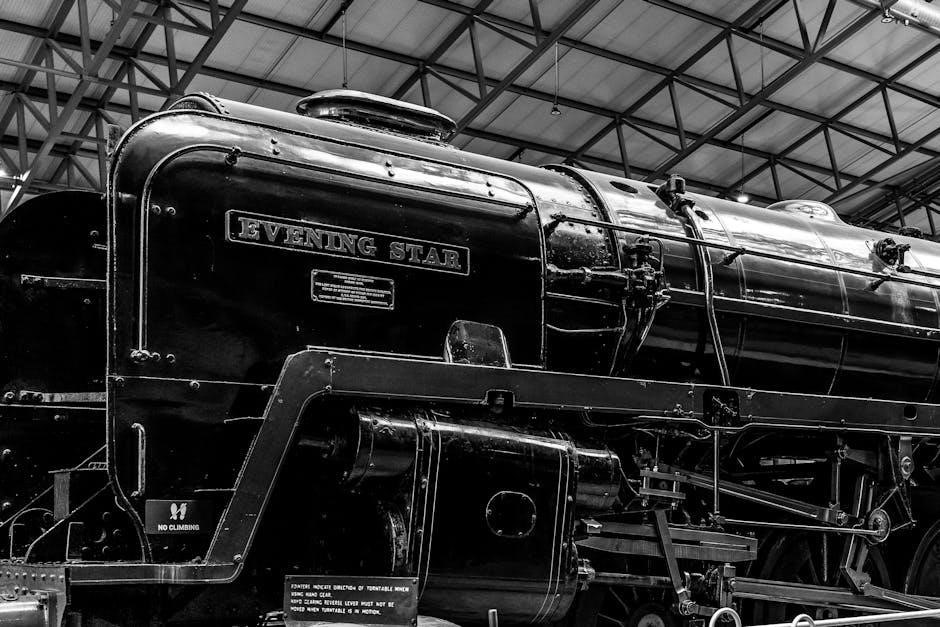
The story’s inherent drama – a stolen train, a relentless pursuit, and acts of courage and desperation – lends itself well to visual storytelling. The availability of Smith’s detailed PDF contributes to a more informed public understanding, influencing how the event is presented and perceived in popular media, ensuring a richer and more historically grounded representation of this pivotal moment in Civil War history.
Legacy and Commemoration of the Event
The Great Locomotive Chase continues to resonate as a symbol of Union bravery and ingenuity during the Civil War. Commemorative efforts range from historical markers along the route to reenactments that bring the daring raid to life. However, a deeper understanding of the event is significantly enhanced by resources like Robert W. Smith’s comprehensive account, frequently accessible as a PDF.
Smith’s work provides crucial context, moving beyond simplistic narratives of heroism to explore the motivations, challenges, and ultimate fates of all involved – both raiders and pursuers. The PDF format allows for widespread access to this detailed historical analysis, fostering a more informed public memory. This detailed account challenges romanticized versions, presenting a balanced perspective;
The legacy extends beyond historical study, influencing interpretations of courage, sacrifice, and the impact of strategic disruption. The readily available PDF of Smith’s research ensures that future generations can engage with a nuanced and well-documented account of the Great Locomotive Chase, preserving its significance within the broader context of Civil War history and beyond.